Showing posts with label Atlético Madrid. Show all posts

Saturday, May 24, 2014

Real Madrid 4-1 Atlético Madrid (AET): The deceptive scoreline

For the first time in the history of the competition two teams from the same city met in the final of the Champions League. Atlético Madrid, recently crowned Spanish champions (at the Camp Nou, no less), were facing Real Madrid, still in search of the ever elusive Décima.


Given the injuries and suspensions on both sides, there were no major surprises on the teams' line-ups apart from the impressive Raphaël Varane in Pepe's place, with Sami Khedira offered the spot that usually belongs to Xabi Alonso. On the colchonero side, Diego Costa managed to recover only to limp off after a few minutes had elapsed, making way for Adrián.

  • Few surprises

The pattern of the match pretty much followed the expected pattern. Unlike last week at Barcelona, Diego Simeone instructed his men to stand down and exert no pressure as Real Madrid centre-backs tried to bring the ball out from the back. Rather, the new Spanish champions were virtually defending in some sort of 4x6x0, with both David Villa and Diego Costa placing themselves close to their midfield so as to force their opponents to play outside their compact block.

The colchoneros were all too happy to cede the initiative to Carlo Ancelotti's men, who have always looked most vulnerable this seasons where they were offered the time to build up play, rather than relying on deadly quick transitions based on Karim Benzema, Cristiano Ronaldo and Gareth Bale.

Real Madrid managed to complete almost twice as many passes as Atlético.

With Raúl García deputising for Arda Turan, Atlético's right wing was even tighter defensively, with García offering invaluable help down the left, where Fábio Coentrão and Ángel Di María tried to find a breach in Atlético's hard-knit defensive unit.

  • The Di María role

In fact, Di María's part was the most interesting from a tactical point of view, since he was being asked to act as a shuttler while defending - deployed ahead of Khedira and alongside Luka Modric - and as a winger when the team attacked. The knock-on effect was that Cristiano Ronaldo, clearly playing with severe physical limitations but unwilling to relinquish the chance to win the club's tenth cup and his second, was allowed (and instructed) to get into more central positions, closer to Benzema, probably because the Portuguese was not able to put in his blunt sprints.

Ronaldo was physically unavailable for sprinting and was more of a central presence.

While this approach is far from an absolute novelty this season, it seemed strange that Ancelotti would make such an option here, since Ronaldo seems to struggle whenever he's asked to play as a central forward: On one hand, there is a lot less space for him to move into given the greater number of players in that area and, on the other hand, not only he is forced to play with his back to goal, but he also relinquishes the possibility of running at defenders with his incredible speed.

Di María was asked to perform two roles, but as time went on, he became an out-and-out winger.

Atlético, in turn, did not appear in any way surprised by Reals strategy and were in fact aiming their long ball to the left side of Khedira, who was clearly lacking in match fitness. Not only did Di María was absent due to his attacking forays down the wing, but Atlético also had Raúl García down the right - an option that paid great dividends against Barcelona in the competition's semi-finals, where he made the most of the height mismatch between Jordi Alba and himself.

  • The inability to create

Following Bayern Munich's dismantling in the previous round and Barcelona's falling at the seams under the leadership of Gerardo Martino, it seems possession-based football will be that much harder to come by. In fact, both Real Madrid and Atlético were clearly interested in taking full advantage the moment their opponents lost their balance while attacking. All things considered, that was pretty much what happened, as both sides only looked dangerous on the break or following a mishit pass (Tiago's first-half slip-up immediately comes to mind).

Other than that, neither team were able to create anything of note in possession with their opponents sitting in front of them, further showing both sides' willingness to prey on the other's mistakes. Adrián, Diego Costa's replacement, acted even more as a midfielder, protecting his midfield team-mates from up front, but offering precious little offensively.

Adrián offered a helping hand defensively, but did not contribute much up front.

  • The fifth element

Nowadays there seems to be little arguing about the game's four phases of play: attacking organisation, defensive transition, defensive organisation and attacking transition. There were some who started mentioning a fifth phase of play: Set pieces. With football tending to evolve towards greater and greater athleticism and a diluting of major tactical differences (the Premier League notwithstanding), there seems to be a lot of sense in the "fifth phase of play" approach.

In fact, given that neither team were exactly impressing with their ability to penetrate enemy lines, this was probably the phase that paid the highest dividends and one that will probably attract more and more attention down the line. Not only did Atlético tilted the match their way after a 38th minute set piece dismally dealt with by Iker Casillas (who revealed one of the biggest faults in his game: aerial balls), but Real Madrid would finally find the goal they fought so long for during the second half on the 94th minute via Sérgio Ramos, ever crucial in these passages of play as error-prone in open play.

  • To live and die by one's own sword

Diego Simeone and his men have been praised - and rightly so - for their high intensity, take-no-prisoners approach. Adept at defending compactly and breaking quickly, the colchoneros often work miracles during first halves, only to struggle (not just) physically as time goes by, since that approach is clearly unsustainable. Indeed, they progressively retreated into their own half, not as a strategic move trying to lure Real Madrid into a false sense of security, but rather due to the inability to compete physically.

Even though Real Madrid themselves were not exactly able to create numerous clear-cut chances, it was becoming progressively clear by the minute that Atlético were running on empty and that a Real Madrid goal would not be followed by an offensive stampede from Simeone's charges.

Atlético Madrid were clearly not interested in pressing Real Madrid high up.

The number of clearances made by Atlético inside their own box is staggering.

The last-minute ditch fest that took place for most of the second half was an invitation for Real Madrid to exert even more pressure unto Atlético's already tired defence. Had Xabi Alonso been present, for instance, Modric would have been able to play higher up and assume even greater importance while running the show (his impressive display will likely be forgotten under the due compliments to Di María or Gareth Bale). Wearing the champions crown will surely force Atlético Madrid to be more proactive in more matches, which will be a testing challenge in itself.

  • Conclusion

Carlo Ancelotti won his fifth Champions Leage/European cup both as player and manager, but he was probably a minute away from being shown the door, had Sérgio Ramos failed to blast the ball into the net. The European success will certainly paper over many cracks that were plain for all to see - the inability to create danger when opponents do not offer space behind them and a certain difficulty in winning against strong (mostly) domestic opponents, the impressive destruction of Bayern Munich notwithstanding. A third-place finish is clearly not enough for Real Madrid, even though the European success will help all of that pass by.

As for Atlético, it would be hard to ask a whole lot more of them. With so many injuries, suspensions and without a deep squad, the physical side of things was bound to catch up on them. Simeone's high intensity style, while effective, leaves a mark on players. It remains to be seen if, not unlike Jürgen Klopp's, his approach will not be unsustainable in the long run.

Wednesday, December 11, 2013

Atlético Madrid 2-0 FC Porto: Predictable exit for Dragons

Starting elevens

FC Porto followed Benfica's lead from Tuesday and bowed out of the Champions League, but forgot to observe the Eagles' example and at least win the match, particularly after Zenit did their part and made things harder for themselves.

It seems unfair to blame a team that hit the woodwork three times, had a deflected shot against a post and missed a penalty. Paulo Fonseca will most likely be heard complimenting his team's play and pinpointing bad luck as the chief reason for the side's premature exit from Europe's top competition.

However, PortuGOAL alerted to some of the key aspects that were changing under the former Paços de Ferreira coach and this reporter went as far as saying that the groups draw had been far from fortunate for FC Porto, given how Fonseca had been moulding his team. As it were, a paltry record of no home wins (for the first time in the club's history) and just one victory in six matches was hardly unpredictable, given the abandonment with each the team attacked.

Yesterday was a bit different, but not by much. Atlético Madrid coach Diego Simeone chose to rest some of his players, but still fielded an XI that had Raúl Garcia, Gabi, Miranda and the gem that is Óliver Torres. Simeone stayed true to his beliefs and his team were deployed in an expectant (not to be mistaken for passive) 4x1x4x1 while defending, sitting compact in front of their 18-yard box.

The Dragons were more expeditious in attack and could in fact have scored with just 7 minutes gone, Jackson Martínez connecting with Danilo's left-footed cross only to see the shot rebound off the crossbar. Seven minutes later, Atlético Madrid would score through Raúl Garcia from an impossible angle. While Helton could certainly have done better, the whole defensive positioning in a simple throw-in left a lot to be desired as well.

Lucho González was asked to contribute more in midfield during the build-up phase, but there was not much going on in central areas, an issue proven by Fernando's need to try to provide airborne through-balls or even a shot from way out. 

As a result, FC Porto kept looking to the wings to create danger, and it was from there that Varela headed against the crossbar 7 minutes after Atlético Madrid's first goal. Despite the apparent good signs, the fact that both these good opportunities came from individual approaches spoke volumes about the team's approach for the season.

Adding insult to injury, Josué missed his first penalty in an FC Porto kit, after Jackson Martínez had single-handedly won a foul from Aranzubia, Atlético Madrid's 'keeper. In Fonseca's words, luck was having nothing with his side.

  • Irony on the wings
For a team that keeps insisting on playing down the flanks, the reason why there is so little support to the player that receives the pass on the wing is hardly fathomable. The team clearly resents the lack of a central creator and invariably gets the ball out wide, but no player apart from the full-back and the winger (at best) ever seems inclined to get close to those positions. Not only does the team struggle to get past opponents, but they also suffer from the distance between the ball and the position of central midfielders (in this case, Defour and Fernando).

With that approach, opposing defenders have time and space after winning the ball back to pick their pass, which in turn allows the forward (in this case, Diego Costa for the most part) to receive the ball and turn to goal. 

The defensive transition is clearly the (main) Achilles' tendon of this FC Porto side. Atlético Madrid's second goal proved just that, when Jackson Martínez' deflected shot met the post. The subsequent corner was typical of this season, when a potential attacking opportunity quickly turned into a wide avenue for Diego Costa to round off Helton and expertly bury the ball in the back of the net.

The departure for the Europa League may not necessarily be the worst scenario for FC Porto, but Paulo Fonseca's position as the team leader is fast approaching untenable levels, with just 2 wins in their latest 9 matches. The adjustments Fonseca had talked about in the past seem not to have been implemented and the dip in the team's confidence will not help the least bit, in all likelihood.

Thursday, May 10, 2012

A rough year for tiki-taka

Starting elevens
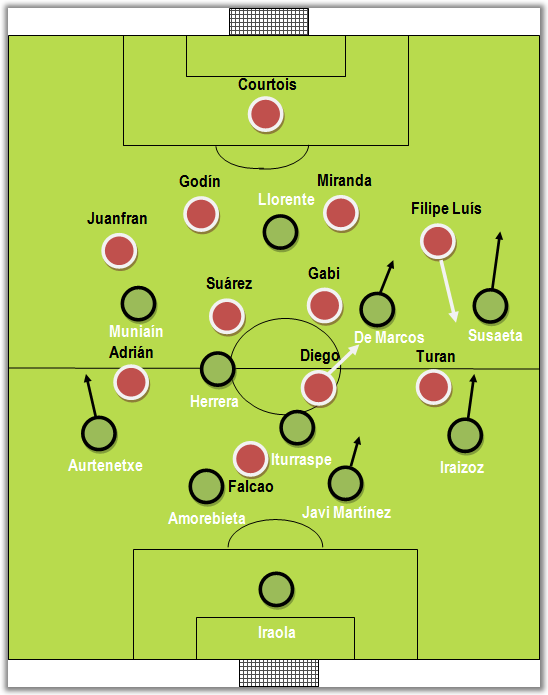
Bilbao and Atlético Madrid met yesterday for an all-Spanish Europa League final. Even though Falcao stole the show and eliminated all doubt (if any) surrounding his worth by offering his team the cup on a silver platter, there is a broader issue to take into consideration: could this be the end of an era of passing football and the rebirth of catenaccio?

The match started off in a very lively fashion. It wasn't hard to envisage Bilbao playing and pressing high, but Atlético were by no means shyer and tried to stifle Bilbao in their build-up phase (something that Bilbao were clearly not expecting and for which they didn't seem to have a proper solution). With both wingers high up and just the back four and Iturraspe near the ball, the Basques were finding it very hard to bring the ball out from the back and, indeed, Atlético often managed to get the ball back in very dangerous positions with little defensive coverage from Marcelo Bielsa's men.

Up to Falcao's first goal, Atlético pressed high up, keeping Bilbao from playing out the back.

Atlético consistently forced Bilbao backwards and always had a player on Javi Martínez.

As seen here, Bilbao were a broken team, with acres between their lines,
repeatedly exposing themselves to risk.

After the first goal, the rojiblancos dropped back mainly for strategic reasons. First of all, it would be virtually impossible to keep up the initial pace and they were actually in front. Secondly, if there is one thing Bielsa's team is not so good at, it's pressing after giving the ball away, opening up numerous pockets of space for their opponent. With Diego, Turan and Adrián, Atlético were right where they wanted.

Atlético chose to sit back after the first goal, trying to break quickly after getting the ball back.
After the first goal, the match fell into a repetitive pattern, with Bilbao insisting on being (too) vertical and having little patience to open up their adversary, and Atlético retreating, attracting their opponent into the trap and then suddenly counter-attacking. Despite Falcao's goals, the man of the match award should go to Diego. The Brazilian, usually not very adept at defending, was brilliant in the way he was able to take up two defensive positions, effectively blocking Javi Martínez and Iturraspe, Bilbao's two engines.

When the ball got to Javi Martínez, Diego would get high up to meet him.

Five seconds later, Diego was marking Iturraspe.

In fact, Diego's display makes us wonder whether this is 1994 all over again. Back then, Barcelona was known as the Dream Team, led by Guardiola (on the field), on the back of their European Champions' Cup triumph in 1992. In 1994, they played Milan in the final and there were no doubts that the Italians would be crushed, except Fabio Capello's (yes, that Capello) men played a brilliant positional game and picked up the Spaniards' pockets by conceding them the majority of ball possession - setting the tone for almost a decade of sitting back, quick transitions and fast breakaways.

In this year, we have seen several teams that favour an intricate passing style being outfoxed by teams in a defensive 4x4x1x1; the examples of Barcelona, Bilbao, Manchester City, et al, immediately spring to mind. Are we witnessing the end of a cycle? Will this year's Euro confirm the tendency and see Spain going out in flames to a defensive-minded team with two banks of four?